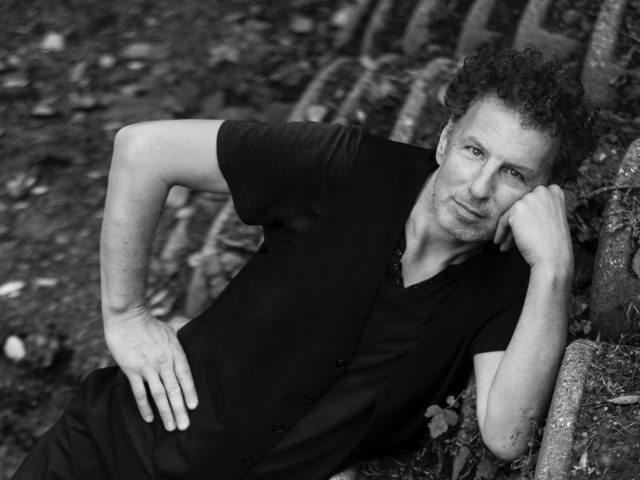
In 2024, director and choreographer Wim Vandekeybus recreated his iconic dance theatre production PUUR with Opera Ballet Vlaanderen. With Bizet's Carmen, he now makes his opera debut. Always vulnerable, always looking for the balance between sensitivity and strength, the choreographer has carved out his own unique place and formal language within the art world. A portrait of an idiosyncratic and versatile body of work:
Wim Vandekeybus (1963) took an unusual path to the international stages. Growing up in the rural Kempen region, he followed his father, a passionate veterinarian, from stable to stable. Despite an academic foray at the Psychology Faculty of KU Leuven, he soon discovered that the lure of creativity and performance was more powerful than the scientific rationality of his education. The turning point came in 1986 when Vandekeybus made his debut as a performer in Jan Fabre's The Power of Theatrical Madness (1984), an intuitive decision that propelled his life towards the stage and the theatre world forever.
A year later, despite a lack of substantial financing, Vandekeybus determinedly founded his own dance company Ultima Vez. The Spanish name referred to his intention that this would be the first and the last time he would undertake something like this. His approach was demanding from the very beginning and constantly under high tension, challenging his performers to give their all, every time, as if it really was the last time. With his debut production What the Body Does Not Remember (1987), Vandekeybus unleashed a true artistic storm. It was no ordinary performance, but rather a raw, physical experience; a tabula rasa of all that had hitherto been known, as he would later describe it. The performance revealed the essence of instinctive reflexes, rooted in the unadulterated reality of existence. It laid the foundations for Vandekeybus's characteristic dance language. Performers threw stones above their heads as they ran across the stage at increasing speed: literally dancing to the edge of the abyss. The performance was awarded a Bessie Award for groundbreaking work in New York and immediately launched Ultima Vez onto the world stages.
Each subsequent production was propelled by Vandekeybus's persistent urge to discover new forms, whether it was a classical mythological piece or a cinematographic performance. Despite the evolution in his artistic expression, the core of his movement language remained unwavering in embracing tension, conflict, the interaction between body and mind, taking risks and following impulses. His artistic expressions unmistakably radiate physicality, passion, intuition and instinct. Each of these elements is continuously given an innovative form in multidisciplinary performances where dance and theatre seamlessly merge with cinema, music and poetry.
A prominent motif in Vandekeybus's oeuvre lies in the human response to extreme situations. He especially emphasises the 'moment of catastrophe', where humour, playfulness and even lightness are not excluded
'An intuitive interaction with the dancers and their mental state'
A prominent motif in Vandekeybus's oeuvre lies in the human response to extreme situations. He especially emphasises the 'moment of catastrophe', where humour,
playfulness and even lightness are not excluded. He does this by involving diverse characters in his work, from artists to non-artists and dancers of different ages and backgrounds. To then create conditions that drive these performers to a point where instinctive responses are provoked by breaking habits and expectations. He places these reactions within the irreconcilable conflict between body and mind, emotion and reason, nature and culture, the collective and individual, and the all-encompassing confrontation between illusion and reality.
Vandekeybus's approach is nevertheless far from theoretical; he operates by his intuition and shares it with his dancers without being forceful. In this relationship, creativity is seen as something childlike and simple, where the best creations do not explain themselves, but arise from instinctive reactions. His choreographies thus reflect an intuitive approach to the mental state of the dancers, where freedom and creativity thrive on stage and each individual can and must make a unique contribution.
In his early performances, text and story became completely subordinate to the body language, steeped in suspense. Each movement told a story of passion, conflict and the human drive for freedom. From 1991 onwards, Vandekeybus also integrated more narrative elements into his creations. In Alle Grossen decken sich zu (1995) the theatre took the lead. Later came works such as Sonic Boom (2003), Oedipus/Bêt Noir(2011) and also in his most recent creation InfamousOffspring (2023), Vandekeybus's artistic process has continued to develop towards the creation of theatrical worlds where movement and text exist in harmony.
A visual artist
Although film fragments were integrated into his productions at an early stage, it was Blush (2003) and PUUR (2005) that intriguingly merged cinema and stage. PUUR was constructed entirely as a dialogue between a feature film, shot in Super 8, and what happened on stage. This experience motivated him to make cinematic adaptations of his performances which could function as stand-alone works, such as Blush (2004) and Monkey Sandwich (2013). In 2015, Vandekeybus temporarily put aside his choreographic shoes and entered the feature film landscape with Galloping Mind. He involved children from orphanages to weave a modern myth about separated twins, steeped in ancient tragedies and human powerlessness. Finally, in Hands do not touch your precious Me (2021), the fascinating collaborative project with Olivier de Sagazan and Charo Calvo, he experimented for the first time with live projections from the stage to try to unravel the deeper meanings of 'body' and 'person'.
The integration of film projections into his performances has thus been an organic process for Vandekeybus. He considers himself a visual artist, thinking in images. He emphasises the importance of pictures that are not fully coloured in. Based on that idea, Vandekeybus avoided overly social content in his earlier period because dance - as an abstract art - must be felt and not necessarily understood. Over the years, however, he developed a refined narrative style. Vandekeybus's performances have increasingly taken the form of associative montages, crossing boundaries between disciplines without losing their deep-rooted autonomy. This approach culminated in his most recent creation, Infamous Offspring (2023), a modern interpretation of Greek mythology where dance and the poetry of Fiona Benson merge both on stage and screen to create a new and unique world. Infamous Offspring therefore evolves into a visual narrative that embraces different media, where cinema coexists with stage performance and dance goes hand-in-hand with spoken word. In this layered approach, the elements reinforce each other, resulting in a unique visual language that takes the audience on a contemporary journey through the timeless stories of Greek mythology.
A visual artist
Although film fragments were integrated into his productions at an early stage, it was Blush (2003) and PUUR (2005) that intriguingly merged cinema and stage. PUUR was constructed entirely as a dialogue between a feature film, shot in Super 8, and what happened on stage. This experience motivated him to make cinematic adaptations of his performances which could function as stand-alone works, such as Blush (2004) and Monkey Sandwich (2013). In 2015, Vandekeybus temporarily put aside his choreographic shoes and entered the feature film landscape with Galloping Mind. He involved children from orphanages to weave a modern myth about separated twins, steeped in ancient tragedies and human powerlessness. Finally, in Hands do not touch your precious Me (2021), the fascinating collaborative project with Olivier de Sagazan and Charo Calvo, he experimented for the first time with live projections from the stage to try to unravel the deeper meanings of 'body' and 'person'.
The integration of film projections into his performances has thus been an organic process for Vandekeybus. He considers himself a visual artist, thinking in images. He emphasises the importance of pictures that are not fully coloured in. Based on that idea, Vandekeybus avoided overly social content in his earlier period because dance - as an abstract art - must be felt and not necessarily understood. Over the years, however, he developed a refined narrative style. Vandekeybus's performances have increasingly taken the form of associative montages, crossing boundaries between disciplines without losing their deep-rooted autonomy. This approach culminated in his most recent creation, Infamous Offspring (2023), a modern interpretation of Greek mythology where dance and the poetry of Fiona Benson merge both on stage and screen to create a new and unique world. Infamous Offspring therefore evolves into a visual narrative that embraces different media, where cinema coexists with stage performance and dance goes hand-in-hand with spoken word. In this layered approach, the elements reinforce each other, resulting in a unique visual language that takes the audience on a contemporary journey through the timeless stories of Greek mythology.
‘Music also functions as a soulful companion and plays a crucial role in all Vandekeybus's choreographic creations'
The mysterious embrace of music and dance
Music also functions as a soulful companion and plays a crucial role in all Vandekeybus's choreographic creations. Since What the Body Does Not Remember, it has assumed the role of emotional conductor, under the direction of Thierry De Mey and Peter Vermeersch. In the following years, composers and musicians such as Charo Calvo, David Byrne, David Eugene Edwards, Marc Ribot, Trixie Whitley, Arno, Daan and Mauro Pawlowski have added their notes to the choreographic score. Vandekeybus unfailingly embraces the harmony between movement and melody. His search for innovation has even brought him to the threshold of silence, where music and dance meet in a mysterious embrace.
‘His search for extremes and his unconventional approach to theatre serve as constant inspiration, not only for the art world, but for everyone who dares to look beyond their own safe horizons’
Vandekeybus is not only an uncompromising maker but also someone who dares to doubt and question his own ideas. Always vulnerable, always looking for the balance between sensitivity and strength, he has carved out his own unique place within the art world. His search for extremes and his unconventional approach to theatre serve as constant inspiration, not only for the art world, but for everyone who dares to look beyond their own safe horizons. Yet its true power lies in its ability to make others discover what they did not know about themselves, an art that reaches into both the physical and mental dimensions. Vandekeybus invites the audience to balance on the edge of the known, then explore the limits of the imagination and embrace the richness of human existence. In this way, his artistic legacy remains not only a challenge for the imagination. It is also a crystal-clear mirror that reflects the inner discoveries of both those who bring his work to life and those who experience and attend the performances.