- Season 26/27
- Vonk
Ghent façades break out
by Door Ilse Degryse / Foto’s Wouter Van Vooren, Thu, Apr 23, 2026
Can residents and tourists share a city? And what does that sound like? These are the questions posed by theatre maker Thomas Verstraeten in his ingenious and spectacular project De opstand van de gevels (The Revolt of the Facades). Together with a city orchestra made up of Ghent residents from all walks of life and two Ghent facades, he is creating the performance (and parade). We dropped by the first meeting.
‘Whether you’re an experienced musician, in a brass band, play the organ or violin, make your own instruments, are a DJ, rap, do body percussion or just fancy trying something new: everyone is welcome!’ That was the open invitation Thomas Verstraeten sent out in the autumn of 2025. For his new project – a parade in which two Ghent façades will swap places, later becoming a performance – he wanted to form a city orchestra that would give Ghent a musical voice. And his message was received loud and clear! Armed with a wide range of instruments, people from Ghent – hailing from far and wide – came to the introductory weekend for the city orchestra on 10 and 11 January at the CAMPO theatre.
We were there on 11 January and saw, to name but a few examples: a twelve-year-old girl with her portable electronic harp, a twelve-year-old girl with a recorder, men and women with saxophones and a double bass, an elderly lady who came to DJ, a Ukrainian percussionist, a bass player, two cousins who came to sing, a young Syrian man with his oud, a young woman with her inherited accordion, violinists, a Brazilian resident of Ghent with self-made instruments…
A ribbon of façades
No wonder director Thomas Verstraeten was delighted when, after the coffee break, he presented his project to the participants. ‘I’ve always had an enormous fascination with and love for the city, as a starting point for understanding the world,’ he said. ‘The major challenges of our time – think climate, migration, gentrification and so on – are first visible in the city. In all my projects, I seek out the poetry in everyday life in the neighbourhoods. Because there you’ll find more truth than on the front page of the newspaper. I firmly believe that.’
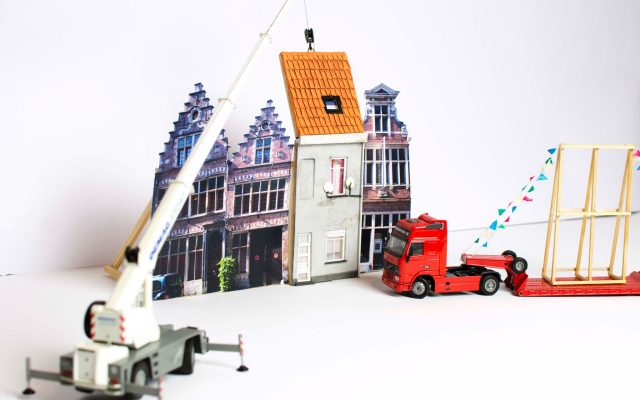
The idea for ‘The Revolt of the Facades’ came to Thomas Verstraeten one day when he visited the Ghent City Museum STAM: ‘I saw an old sketch of Ghent’s facades there, and the story behind it was that from the 17th century onwards, the city of Ghent required all facades to be made of stone. Behind them, there could be a wooden structure, or whatever. That fascinated me and, in my imagination, I saw the image of a ribbon of façades with a void behind them. And perhaps that’s not so far removed from how you might experience Ghent today, I thought… With a medieval centre that has become a sort of demarcated, large-scale Disneyland, with terraces and Nutella shops, Airbnbs and souvenir stalls. That creates a tension with the people who live around it. You see that in all tourist cities – think of Barcelona, Venice, Amsterdam, and so on. Because who does the city belong to? The residents or the visitors? Or can the two coexist?’
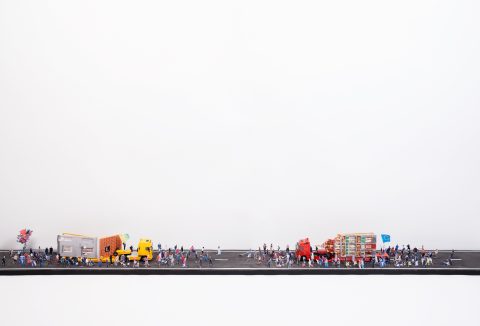
‘That’s how the idea arose to physically swap the positions of two façades in Ghent: one on the medieval-looking Vrijdagmarkt and one in the working-class neighbourhood of Brugse Poort. In practical terms: we choose two houses, place exact copies of the façades in front of the originals overnight, peel them off in the morning, load them onto a truck and transport them through the city, accompanied by a parade in which the whole of Ghent can take part. And then the façades swap places. Sounds simple, doesn’t it? It isn’t! (loud laugh) But the technical teams and workshops at Opera Ballet Vlaanderen are already working flat out to find a solution, and it’ll all come together…’
‘In addition, there will be a series of performances at NTGent. The idea is to give the façades a voice: if they were instruments, what would they sound like? Can we achieve a harmonious sound with a diverse group of people from Ghent? We’ll be exploring that in a series of workshops over the next six months. We’ve set a few ground rules for this. First of all, nothing is predetermined; we’re starting with a blank slate – there are only the façades. The one on the Vrijdagmarkt wants to be medieval and might echo the music of 19th-century Flemish neo-Romantic composers such as Karel Miry. The one in the Brugse Poort might feature hip-hop or rap. We’ll create the performance using your materials and creative ideas. Everyone is welcome; the desire to take part is more important than what you can do. I see myself throughout the process as the traffic controller: I’ll provide starting points for you to work with, and at the end I’ll bring it all together. I’ll be assisted in this by two musical leaders, Wouter Deltour and Helena Casella.’
Getting started
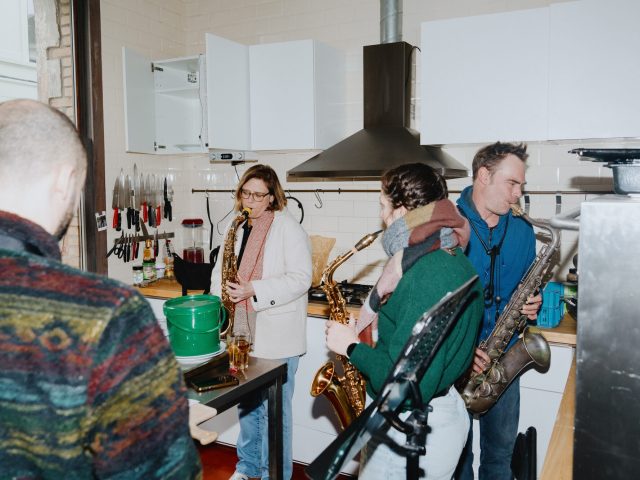
And then, after lunch, comes the first task. The people of Ghent are divided into small groups and Thomas leads them to a table laden with inspirational material. He has brought along some prints: of a medieval execution on the Vrijdagmarkt, a procession of Emperor Charles V, a tollgate… There are newspaper articles about the famous ‘war of the noses’ (for the conical confections nicknamed ‘noses’) at the Gravensteen and about a squatters’ riot in the 1970s at the Brugse Poort. He has printed out a story by Italo Calvino entitled Invisible Cities. The task is to improvise around one of these sources and create a musical fragment lasting a few minutes. You can feel the creativity bubbling up straight away. One group settles in the kitchen at CAMPO – which is a bit cramped with a double bass and four saxophones – while others take their places in the foyer, the technical workshop or simply on stage. Before you know it, the whole theatre is filled with fascinating, clashing, searching, exciting sounds.
After a good hour, the groups present their ideas to one another. It all sounds promising; the traffic controller/director Thomas and his team are standing there beaming. After a jam session with the whole group, there is a closing discussion. Is everyone still keen to take part? Yes, it turns out. We’ll have to see if everything fits into the (family) schedule, but we can count on their enthusiasm. And so, they’ve set off on a wonderful creative journey with two Ghent façades as the key players. See you on 12 September with the rest of Ghent for the Karavaan – during the Odegand music festival – and from late October at NTGent for the performances of De opstand van de gevels.
Join the rest of Ghent on September 12 for the Karavaan - during the Odegand music festival- and starting in late October at NTGent for performances of De opstand van de gevels.

Gent
The uprising of the facades - The opera
Thomas Verstraeten