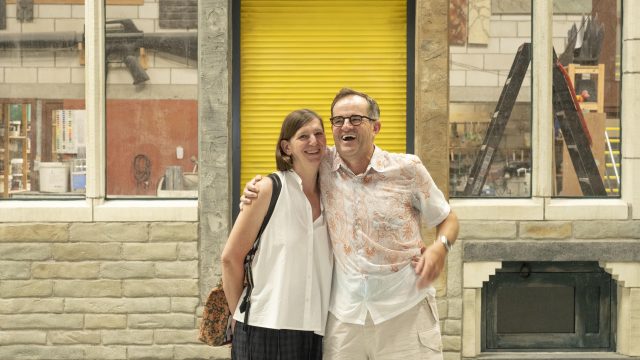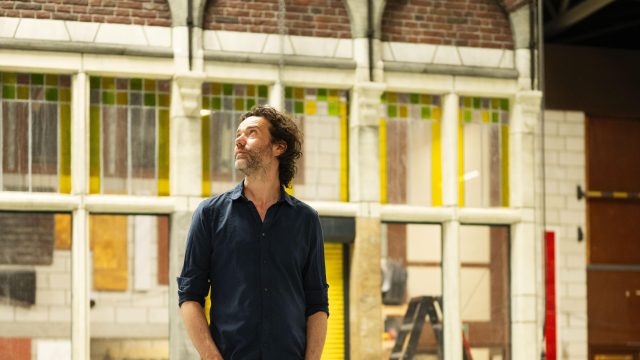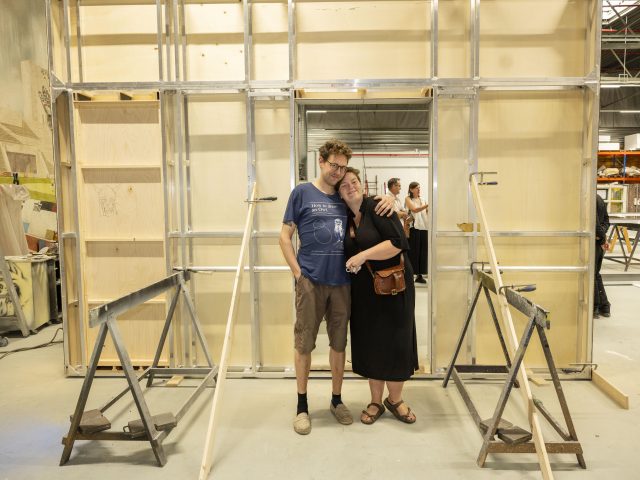
A conversation soon develops about the two neighbourhoods where the façades belong. Caroline and her husband Luc explain that they do not know the Brugse Poort all that well. Stefanie and Thomas, the owners of the house on Fonteineplein, reveal that they shared their first kiss in front of Caroline and Luc’s façade: ‘We had our first date in a café on the Vrijdagmarkt. Afterwards, we walked together to my bicycle, which was parked by Caroline and Luc’s house. We had our first kiss on their doorstep,’ Stefanie laughs. Years later, she and Thomas bought their house in the Brugse Poort. ‘I came to Ghent to study and have been living in the neighbourhood for ten years now. Thomas also quickly felt at home in the Brugse Poort. When we were looking for a new home and saw that a property on Fonteineplein was for sale, we didn’t hesitate. We fell in love with the square.’
Caroline and Luc ended up on the Vrijdagmarkt because Caroline wanted to open a clothing shop there. In 1992, she opened her boutique Oorcussen and moved into the apartment above the shop. The name refers to the history of the building. ‘In the 16th century, the Vrijdagmarkt was home to all kinds of cafés and inns. Luc discovered that the establishment in our building was called Oorcussen. We liked the idea of bringing that name back to life.’ When the boutique opened, the square was mainly home to local shopkeepers.
But a great deal has changed over the years. Many properties on and around the square had to be expropriated to make way for large-scale property developments. The Vrijdagmarkt became car-free and cafés and terraces appeared, along with tourist restaurants and fast-food chains. More and more large-scale events found their way to the square. Residents continued to move away. Today, only a handful of people still live on the Vrijdagmarkt. Caroline and Luc have also recently decided to leave the square. They will remain in the city centre, but are moving both their home and the shop to a quieter neighbourhood. ‘I became increasingly unhappy on the Vrijdagmarkt,’ Caroline says. ‘The disturbance increased and I no longer felt at home there. Much to our regret, we sold the property, and yes: it will be given a tourist-oriented purpose. It is unfortunate and almost inevitable that our house should end up being used in that way. Who still wants to live on the Vrijdagmarkt, let alone run a business there that doesn’t cater exclusively to tourists?’ Luc says he would have liked to stay. ‘But the city should think more thoroughly and critically about how the square is used. Only when there is a healthy mix of residents and businesses, and everyone treats the place with respect and care, can it remain liveable.’