- Season 26/27
- Interview
The search for a distinctive dance language
by © Piet De Volder, Mon, Aug 3, 2026
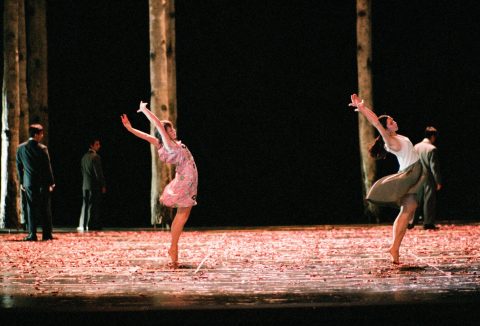
Under this season's slogan À la flamande, we explore the many-coloured roots of our Flemish identity and how they have given rise to such distinctive, internationally acclaimed art – art that is very much alive. Choreographer and OBV associate artist Anne Teresa De Keersmaeker talks about her sources of inspiration and the artists who influenced her, and how she developed her own dance language as a young dancer.
“I have always felt more like a dancer than a choreographer. Above all, I was driven to develop my own dance language, and I approached my work in my own distinctive way. Music has been my first partner from the very beginning.”
ANNE TERESA, AT THE BEGINNING OF THE 1980s, YOUR CAREER TOOK OFF AT A REMARKABLE PACE, AS A DANCER, CHOREOGRAPHER AND ARTISTIC DIRECTOR.
In 1980, I created my first choreography, Asch – I was twenty at the time. In 1982 came Fase, Four Movements to the Music of Steve Reich. A year later, the company Rosas was founded, making its debut with Rosas danst Rosas. I have remained its artistic director to this day. It all happened incredibly quickly... At that point, I wasn’t so much interested in establishing myself as a choreographer. I have always felt more like a dancer than a choreographer. Above all, I was driven to develop my own dance language, and I went about it in my own idiosyncratic way. Music has been my first partner from the very beginning. I was fortunate to be surrounded by fantastic artists, such as Thierry De Mey, who is not only a filmmaker but also a composer and musician. Through him and others, I maintained a lively connection with film, theatre, literature and the visual arts. Those perspectives have nourished me enormously.
YOU ARE REGARDED AS ONE OF THE PIONEERS OF THE FLEMISH WAVE, THE RENEWAL MOVEMENT IN DANCE AND THEATRE OF THE 1980s AND ’90s. CHOREOGRAPHERS AND THEATREMAKERS SUCH AS WIM VANDEKEYBUS, ALAIN PLATEL, JAN FABRE AND IVO VAN HOVE ARE ALSO ASSOCIATED WITH THIS MOVEMENT. DID YOU FEEL CONNECTED TO THESE ARTISTS AT THE TIME?
To be honest, no. But that had everything to do with the timeline of the Flemish Wave. Wim Vandekeybus made his debut in 1987 with What the Body Does Not Remember. I only discovered Alain Platel’s work much later. An iconic production such as Bernadetje, for example, dates from 1996. In 1982, the year of Fase, Jan Fabre broke through as a performance artist with the marathon performance Het is theater zoals te verwachten en te voorzien was.
THE FLEMISH WAVE WASN’T AN ARTISTIC GROUP ACCORDING TO YOU?
That’s not how I experienced it. I did, however, feel part of a community in Brussels. That avant-garde scene was shaped in part by the Schaamte collective and Maatschappij Discordia. It was the beginning of Kaaitheater, with Hugo De Greef as its driving force. Alongside Fabre and Rosas, Jan Decorte and choreographer Steve Paxton were also on the programme. What connected us, in both dance and theatre, was that we worked outside the established circuit. You could also experience the international theatre avant-garde elsewhere in Brussels. In addition to Kaaitheater, there were the Halles de Schaerbeek, where I saw Dodenklas by Tadeusz Kantor, and Théâtre 140. Bob Wilson and The Wooster Group came to Brussels, and it was during that period that I discovered Pina Bausch at La Monnaie, for whose work I have always had great admiration. Her work, rooted in the tradition of German Expressionism, was vastly different from American dance. I also discovered the work of William Forsythe during that period.
YOU STARTED YOUR CAREER WITH A CLASSICAL DANCE EDUCATION.
I had an intensive dance education that was initially rooted in classical ballet. I was immensely fortunate that my mother supported and helped me so much, and that I had such inspiring teachers. At the dance school my mother had founded in Wemmel, she invited Lieve Curias from the Ballet School in Antwerp. She taught us not only classical ballet but also modern dance, improvisation and jazz ballet. She took us to performances by Ballet van Vlaanderen and Maurice Béjart’s Ballet of the 20th Century.
YOU ALSO STUDIED AT MUDRA IN BRUSSELS, MAURICE BÉJART’S LEGENDARY DANCE SCHOOL.
I studied there for two years. Mudra shared its studios with the Ballet of the 20th Century. I saw some extraordinary ballet dancers working there, such as Jorge Donn, Suzanne Farrell and Rita Poelvoorde. My desire to have more than just a classical training, combined with my interest in modern and postmodern dance, eventually brought me to New York, where I studied at the Tisch School of the Arts. Above all, I was fascinated by American choreographers such as Trisha Brown, Steve Paxton and Lucinda Childs. At one point, I decided to close the mirror. In ballet training, you dance in front of the mirror and are trained in a strictly prescribed movement language. When I stopped doing that, I began to trust my instincts and started developing my own dance language, literally step by step. That is how Violin Phase, my first solo, came about, followed by Come Out and Piano Phase. Together with Clapping Music, these choreographies became Fase, Four Movements to the Music of Steve Reich. I was not only rather idiosyncratic, but also a workaholic.
Bausch, Forsythe en Brown
‘The dance language and body of work that Pina Bausch created with her company remain unique. Her Sacre du Printemps is still incontournable."
DE KEERSMAEKER’S EXPERIENCES AS A YOUNG DANCER AND CHOREOGRAPHER WERE LATER PASSED ON THROUGH P.A.R.T.S. (PERFORMING ARTS RESEARCH AND TRAINING STUDIOS), THE DANCE SCHOOL SHE FOUNDED IN 1995 TOGETHER WITH BERNARD FROUCRILLE, THE THEN DIRECTOR OF LA MONNAIE. ALONGSIDE DE KEERSMAEKER’S OWN OEUVRE, THE STUDENTS’ CURRICULUM INCLUDED RENOWNED NAMES SUCH AS TRISHA BROWN, WILLIAM FORSYTHE AND PINA BAUSCH. THESE ARE THREE CHOREOGRAPHERS WHO HAVE PARTICULARLY INSPIRED HER AND WHOSE WORK IS REGULARLY PERFORMED TODAY BY OPERA BALLET VLAANDEREN.
In the early days of P.A.R.T.S., I drew on my own experiences as a dancer, student, choreographer and audience member. Bausch, Forsythe and Brown were important examples for me. Each of their names represents a very distinct universe, an exceptional way of shaping dance in the second half of the 20th century. They were deeply engaged in developing their own vision of dance, their own form of writing and their own dance vocabulary. This applies to Pina Bausch’s Tanztheater, in which dance and theatre become one. Forsythe explicitly drew on his experiences as a classical ballet dancer. He expanded and opened up the classical dance language in a brilliant way. Trisha Brown belonged to the post-Cunningham generation (the American generation that came after choreographer Merce Cunningham (1919–2009), ed.). She also worked intensively with visual artists such as Robert Rauschenberg and Bruce Nauman.
PINA BAUSCH IN PARTICULAR WAS AN ICON FOR YOUR GENERATION. HER OEUVRE CONTINUES TO FASCINATE AND MOVE PEOPLE.
The dance language and body of work she developed with her company remain unique. Her Sacre du printemps is still incontournable. Through dance, Pina developed a very distinct form of theatre that constantly challenges us as an audience to question who we are, where we come from and where we are going. She was surrounded by exceptional dancers and collaborators such as set and costume designers Rolf Borzik and Peter Pabst and costume designer Marion Cito. Together with them, Pina created a universe that is at times Shakespearean and possesses an exceptional dramatic force. I remember Pina presenting her production Nelken at the Cour d’honneur in Avignon when we performed Rosas danst Rosas there in 1983. These are events that stay with you.
Antwerp | Gent
Bartók/ Beethoven/ Schönberg
Anne Teresa De Keersmaeker