Excessive and redemptory
by Anna Leon, Tue, Mar 24, 2026
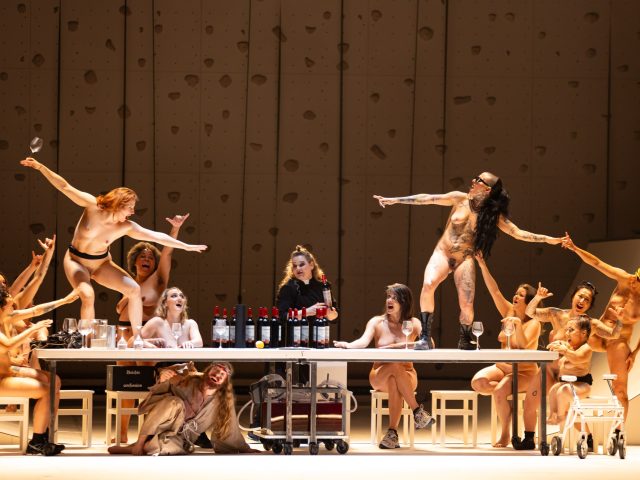
There is no trigger warning before Catholic mass. Yet mass involves looking at a person clawed into a cross with nails poking through their hands, blood dripping from a crown of thorns forced onto their head; it involves eating what looks like bread but might actually be the body of the person on the cross; it involves listening to tales of torture, pain and desperation that might befall some of us after we die. This surprisingly-not-disallowed-for-kids setting layers a history of – very real – violence: from women dying because of denied abortions to people tortured and burned alive; from divine justifications of colonialism and racism to multiple expulsions of Europe’s religious minorities. Florentina Holzinger’s SANCTA brings more than seventy performers on the stage to turn the gore of mass and the violence of the history of the Church into the hands of those who have, in different ways, been its targets. Spiderlike and dark, loud and excessive, funny and redemptory, SANCTA is the trigger warning for mass.
Opera has often sublimated mass, contributing to an emotional and spiritual experience disconnected from the violence perpetrated in the name of religion. But it is a very particular and underacknowledged part of opera’s past that forms the starting point of Holzinger’s work: Paul Hindemith’s 1922 short opera Sancta Susanna, in which a nun confronts the violent punishment of sexual self-determination. And like a nun that refuses to accept the norms restricting her lust for the divine, SANCTA embodies opera by reclaiming it. Bach, Gounod, Rachmaninoff and other top-chart liturgical hits are reinterpreted by a choir of female* voices. Conductor Marit Strindlund navigates a musical landscape that disrupts operatic opulence through metal and noise. Through inputs by contemporary composer Johanna Doderer, Born in Flamez and Stefan Schneider, the music is pushed to extremes of vocalisation, forced to say what it might have been written to help forget. The performers’ bodies – vocal cords, larynx, muscles, bones, sweat – turn into instruments that interpret but also take hold of the music.
A skating ramp leads to redemption while the Sistine Chapel turns into a climbing wall, Bach into metal, God into robot, opera into rock musical. Mass turns into spectacle and, in Florentina Holzinger’s words, real magic needs to happen
Much of the violence of the Church is related to sexuality. Some of it is exerted onto vulnerable bodies, as scores of abused children would testify if their voices were sought and heard. Some of it is drilled into bodies, internalised and performed anew, through the pathologisation of (female*) subjectivities deemed deviant, the de-legitimation of sex for pleasure or work, the privatisation of heteronormative sex, the overt stigmatisation of homosexuality, the pressure towards unattainable physical purity. Beyond the control of feminised bodies, the profoundly male-dominated hierarchy of the Church has played a crucial role in constructing pervasive archetypes of femininity: Eve and the normalisation of childbirth pains, Mary and long-standing social obsession with virginity, Mary Magdalene and the marking of women as playing cards in a negotiation between the saintly and the unclean. If the Church disciplines and punishes sexuality now to achieve salvation later, SANCTA reclaims sexual sensations, experiences and practices, and stages them as a pathway to not-only-religious ecstasy, in an act of sisterhood with Sancta Susanna’s refusal to subsume desire to discipline. And such reclaiming is work: there is construction work – ropes, hammers, a cement machine – on Holzinger’s stage, and there is sex work too, the counter-archetype for sexual self-determination.
But there is, for many, more to the Catholic faith than gore and violence: there’s also magic and spiritual transcendence. Catholic mythology is a repertoire of non-rationalist transformations: a lotus flower turns into a divine pregnancy, water turns into wine which then turns into blood, bread turns into flesh. Religious storytelling is a treasure-trove of miracles: a person walks on water while another parts the sea in two, food appears miraculously for a group crossing the desert, and quite a few people are brought back from the dead. In SANCTA, theatre becomes public ritual, seeking magic in spectacle. Body modification artists twist the religious topoi of scarification, penetration, blood and transformation into on-stage metamorphoses. Performers use training and discipline to develop super-human skills, and show magicians propose their take on the Bible’s miracles. A skating ramp leads to redemption while the Sistine Chapel turns into a climbing wall, Bach into metal, God into robot, opera into rock musical. Mass turns into spectacle and, in Florentina Holzinger’s words, real magic needs to happen.
Antwerp
Sancta
Florentina Holzinger
