- Season 26/27
- Interview
‘I want to feel a sense of urgency in everything’
by Jasper Croonen, Thu, Apr 23, 2026
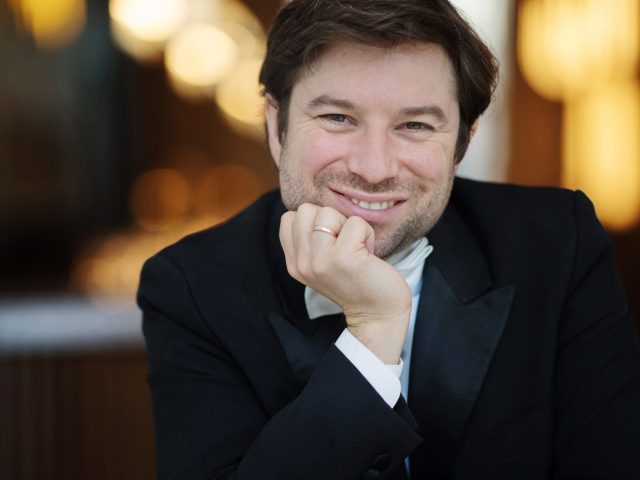
OBV welcomes German conductor Stephan Zilias. Our new music director is brimming with enthusiasm, charm and irrepressible curiosity. ‘If we’re not curious, we’re dead,’ he says in this introductory interview. ‘And I’m not just talking about music, but about life in general. That idea really is a guiding principle for me. It keeps me young, fresh and alert.
Music director Stephan Zilias won’t officially take up his post for a few months yet, but he’s already keen to get to know his new place of work – Belgium – better. What was supposed to be a conversation about his new role at OBV suddenly turns to the painter Michaelina Wautier, a contemporary of Rubens. We even touch briefly on the history of Neutral Moresnet. Not exactly Belgium at a glance. Zilias asks about it all without pretension, not in a pushy way, just genuinely interested. When I broach the topic of his plans at OBV, he neatly deflects with questions about our Belgian media landscape. Before I can probe into his favourite composers, I have to field his questions about David Van Reybrouck’s oeuvre.
It is no coincidence that the conductor cites curiosity as his driving force, ‘along with enthusiasm and joy, because this is above all a joyful appointment for me. I’m very happy to be able to bring my passion and enthusiasm to this house. But as someone who grew up in the German tradition of the Kapellmeister, I’m also very much looking forward to discovering OBV’s new musical DNA.
‘As a conductor, it was clear from the very start that I wanted to do opera. I’ve always found it endlessly fascinating. Where else, apart from opera, do you find such a collaborative project?’— Stephan Zilias
So, you seem particularly curious about the people and the institution. Are you just as curious about music?
Of course, the music I like is music that I find somehow stimulating. With every piece, I ask myself a whole host of ‘why’ questions. Why should I perform this? Why does this have anything to do with me? Why this piece and not another? Why do I feel an affinity with it, while someone else with a different perspective does not? Why might I be able to add something to this music? Why does this music still have something to contribute today? Why is it still relevant?
Take a work like Lohengrin. That libretto contains lines such as ‘Für deutsches Land das deutsche Schwert!’, accompanied by militaristic music that feels very uncomfortable given what transpired later. But why did Wagner put that there? You can only understand that if you view it from his perspective. The composer actively took part in the May Uprising in Dresden (in which left-wing revolutionaries attempted to bring about German unification, ed.). As a result, Wagner himself became a political refugee. That fact made me realise that those lines are not so much meant to be encouraging, but threatening.
Do you always manage to stay so curious?
If we’re not curious, we’re dead. And I’m not just talking about music, but about life in general. That idea really is a guiding principle for me. It keeps me young, fresh and alert. Routine has its advantages, but carries the risk of becoming a dead end.
How do you avoid that?
I think there are two things I do to avoid getting bogged down in habits. On the one hand, I don’t think too much about what I’ve done before. I don’t dwell on what has worked – or hasn’t worked – in the past. Every new production is an opportunity to approach a work with a fresh perspective. On the other hand, there are just some works where I cannot find that personal significance. I avoid those. That has nothing to do with the artistic quality of those creations – often, I even think they’re fantastic – but I simply don’t know what to make of them. In everything I conduct, I want to feel an urgency, a reason to do the work.
As a conductor, even as a music director, you’re only a part of the bigger picture. To what extent does that urgency, that motivation, have to correspond with that of the director?
Completely! You’re all jointly trying to present a shared vision of the work, or at the very least to find meaning in it collectively. Some creators struggle with that, because no single person is in charge. I think one of the great plus-points of this house is that the conductors are involved so early in the creative process. I’ve always found it strange – and to put it bluntly: stupid – when the maestro only gets onboard at the last minute. Then he starts commenting on the positioning of the singers and the sound… That’s too late, isn’t it? You don’t start on the first day of the orchestra rehearsals. Your first working day is the moment you know you’re going to do a production. I’ve learned so much from my collaborations with good directors and artistic teams – because it’s obviously also about the set builders, the costume designers, the lighting designers… They’re all such fascinating professions.
It almost sounds as if you’ve chosen the wrong career.
No, I couldn’t and wouldn’t want to trade places. But as a conductor, it was clear from the very start that I wanted to do opera. I’ve always found it endlessly fascinating. It’s an enormous luxury and a pleasure to work with passionate people, where everyone contributes to creating something greater than the sum of its parts. Where else, apart from opera, do you find such a collaborative project? There are people who make shoes, who buy hats, who prepare the scores in the library, who perform, conduct, sing, boost ticket sales, take your coat… It’s an incredible microcosm, a world unto itself. I see that same sense of wonder now in my two sons. The eldest is nine and his eyes light up when he enters a theatre. He naturally has a passion for music, but his favourite spot in an opera house is next to the stage manager.
Doesn’t that spoil the magic?
On the contrary. For me, that spot has something magical about it, because that’s where the craftsmanship becomes clear. Those superhuman spectacles are, after all, simply made by people. That’s what makes it both so enchanting and so down-to-earth.
Yet that’s not the image people associate with opera.
For as long as I can remember, people have said it’s bourgeois, for a wealthy elite, inaccessible. I don’t agree with that. Opera has moved us for centuries. When done well, it touches us as human beings, all human beings. Emotions aren’t class-bound.
As music director, you’re responsible not only for the operas but also for the concert programming. Do you need the same sense of urgency in abstract music?
I certainly feel the same need to perform the symphonic repertoire alongside opera. Concerts are absolutely part of our work with the orchestra and the chorus – because I want to involve those wonderful singers as much as possible. It’s true that I feel most in my element when there’s a plot. But music without a narrative is not necessarily abstract to me. Quite the contrary. Every symphony can suggest a story. There’s always something to be found. The composer was surely thinking of something while writing. I find it fascinating, for example, how Bruckner, at a time when he was desperately trying to get his symphonies performed, sometimes wrote programme notes because the symphonic poem was then in vogue. I’m sure that, when he wrote the music, he wasn’t thinking of birds or that sort of concrete imagery – even if it does fit, in retrospect. Ah well, if it’s convincing and personal, it can all make sense. That’s the beauty of classical music: there are so many valid approaches.
So, a little less urgency, but just as much curiosity.
I have no preference for any particular period within the repertoire; I’ve performed Haydn symphonies and contemporary works, but I simply love music that’s complex. By that I don’t mean it has to be difficult for the listener. I just like it when I don’t understand something the first time I open a score. I love things that make me think. Next year there’s a project around Peter Benoit on the programme, I know almost nothing about it yet. But I’m already looking forward to digging into the information. Oh, perhaps you could tell me where best to start?
Antwerp | Gent
Sibelius 5

Antwerp | Gent
Lohengrin
Richard Wagner

Antwerp | Gent
Schubert 9
Antwerp | Brugge
Lucifer en De Schelde
FC Bergman / Peter Benoit