- Season 26/27
- Column
What is Flanders forging?
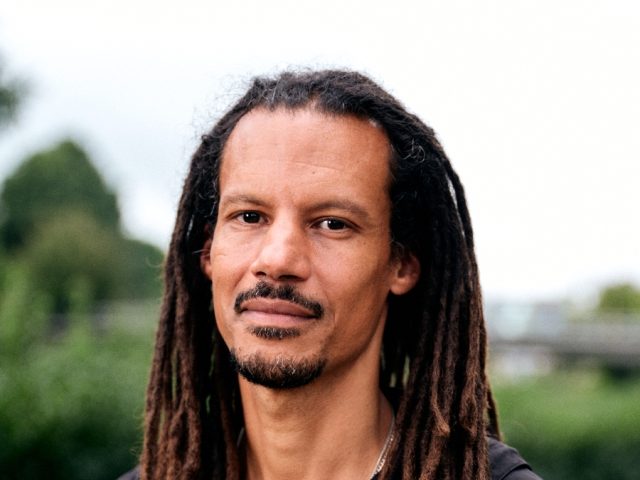
by Sibo Kanobana / portrait photo: © Joris Casaer, Thu, Apr 23, 2026
What does it mean today to create a ‘Flemish’ opera? I believe it is not about a work of art that holds up an image of Flanders as purely innocent or unblemished, but one that dares to dig deep into the moral, political and historical layers of this fascinating place of cross-pollination and violence. Der Schmied von Gent turns out to be just such an opera, precisely because it refuses to portray Flanders as pure, unambiguous or clearly defined.
Central to the story is the figure of Smee: blacksmith, rogue, opportunist, capitalist. All these things at once. No hero, but a nexus of contradictions. Resistance fighter and collaborator. He effectively does resist oppression, and rightly so, but at the same time he also profits from it. He is a victim of power, yet seizes power for his own advantage whenever he can. In Ersan Mondtag’s dramaturgical interpretation, after his death Smee even becomes the embodiment of the oppressed who is simultaneously to blame for colonial atrocities: cast out by both heaven and hell. This is no gratuitous provocation, but a sharp historical insight. After all, colonial history is not a peripheral story, but deeply rooted in recent Flemish history, and that history is not always populated by clear-cut good guys and bad guys.
The Age of the Flemings
Historical research shows how the emancipation of the Dutch-speaking population in Belgium, the so-called ‘Flemings’, is closely intertwined with the colonial project. In the 19th century, Flemings were systematically marginalised: excluded from power, even described as a ‘primitive race’ in pseudo-scientific research, and their language dismissed as suitable only for speaking to animals and servants, and thus inappropriate for what was considered ‘high culture’ and serious governance. This structural exclusion limited social mobility within Belgium itself. The colonisation of the Congo in the late 19th century offered an alternative space for the Flemish. Flemings were therefore heavily over-represented there, particularly as missionaries and lower-ranking colonial officials. The Fleming was the ‘little white man’ who was sent deep into the Congolese interior. That presence was so pervasive that the colonial period is known today in Lingala as tango ya Baflama: the age of the Flemings.
This ambiguity makes the opera uncomfortable, and precisely for that reason also necessary, liberating and enriching.
The Fleming was, in fact, the white man with whom the black Congolese generally first came into contact. Through participation in the colonial apparatus, Flemish people were able to assume positions of power that remained unattainable in Belgium. By actively participating in the oppression of another population, they gained access to the Western bourgeois norm, first as white men in Congo, then as legitimate Flemings in Belgium. Moreover, the expansion of social and linguistic rights in Flanders was partly supported by the economic proceeds of the colonial exploitation of the Congo. While rights in Belgium were gradually expanded for the marginalised Flemings, they were systematically denied to Black subjects in the colony. Flemish prosperity and social protection were therefore conditional and proved to be largely dependent on the colonial enterprise.
The traces of this are still visible today. Flemish political interests are too often presented as opposed to those of racialised migrants. Flemish identity is portrayed as an orderly, hard-working, normative ‘white’ persona, alongside which non-European migrants are seen as disruptive or threatening. This framework can only be understood within a colonial history in which the Flemish, once marginalised and oppressed themselves, were able to acquire a legitimate status as oppressors. A contemporary analysis of what it means to be Flemish therefore cannot be separated from this past. The marginalisation of the Flemish and their subsequent recognition as a respectable European population group came about historically through the exclusion and dehumanisation of others. This clashes with the dominant narrative of emancipation, which casts the Flemish as poor but just, oppressed but honest, culturally misunderstood but morally superior. What that narrative conceals is that Flemish emancipation – just like the emancipation of numerous traditionally marginalised European population groups – unfortunately took place within the logic of colonialism, not outside of it.
Flanders has always existed on the basis of multilingualism, cultural diversity and a connection with other worlds. Culturally speaking, we are all bastards
A new alloy
In Der Schmied von Gent, this becomes apparent through the character of Astarte, who grants Smee access to the ‘treasures of the Congo’. As an erotic and demonic figure, she embodies the colonial apparatus of the imagination, in which desire and violence, lust and denial coincide. This ambiguity makes the opera uncomfortable, and precisely for that reason also necessary, liberating and enriching. It forces us not to think of Flanders as a homogeneous, one-dimensional whole, but as a historically contingent, composite and ambiguous process.
The same applies to our language. Dutch is not a neutral instrument, but bears traces of power and exclusion. Those who speak are heard; those who deviate must justify themselves. Against this backdrop, Opera Ballet Vlaanderen’s decision to use Dutch as the sung language in several productions is by no means an identitarian, nationalistic gesture; on the contrary, it is rather a critical act. The focus here is not on the time-honoured protection of ‘our language’, but on the question of what stories we continue to tell through it, and who is taken for granted as belonging within them.
Perhaps that is the task of the Flemish cultural smith today: not to forge pure steel, but time and again a new alloy, one that makes Flanders more expansive, more humane and fairer.
Flanders has always existed on the basis of multilingualism, cultural diversity and a connection with other worlds. Culturally speaking, we are all bastards. It is precisely therein that the possibility of international solidarity and radical humanism lies. As the Indian writer Amitav Ghosh writes, we need new stories for this in order to break free from the ideological cages of nationalism, colonialism and capitalism (and the ecological destruction that goes hand in hand with them).
Opera can attempt to open up such a space. Not to affirm Flanders as a bounded territory and a pure culture, but to rethink it time and again. Perhaps that is the task of the Flemish cultural smith today: not to forge pure steel, but time and again a new alloy, one that makes Flanders more expansive, more humane and fairer.
Who is Sibo Kanobana?
Sibo Kanobana is a senior lecturer in sociolinguistics and postcolonial theory at the Open University. He is the editor of the essay collection Zwarte bladzijden. Afro-Belgische reflecties op Vlaamse (post)koloniale literatuur (2021) and the author of Witte orde. Over ras, klasse en witheid (2024) and Lumumba’s droom. Wat zijn gedachtegoed ons vandaag kan leren (2025). He was an editor at rekto:verso from 2016 to 2024 and was part of the guest editorial team for the issue Tervurologie (June 2025). He wrote this column at the invitation of Opera Ballet Vlaanderen, as a reflection on the opera Der Schmied von Gent.

Antwerp | Brugge
Lucifer en De Schelde
FC Bergman / Peter Benoit